
Sattva Songbird Masterplan
Phase 2's master plan is the blueprint for how twin 42-storey towers, landscape, clubhouses, and circulation coexist on a 4-acre slice of the wider Songbird community. Read it to judge privacy, sunlight, and how busy the podium will feel once both towers fill. From a planning angle, Sattva Springs keeps the reference local: internal roads, open-space placement, amenity access, and tower orientation all affect how the address will live after handover.
How the larger site seems to be organized
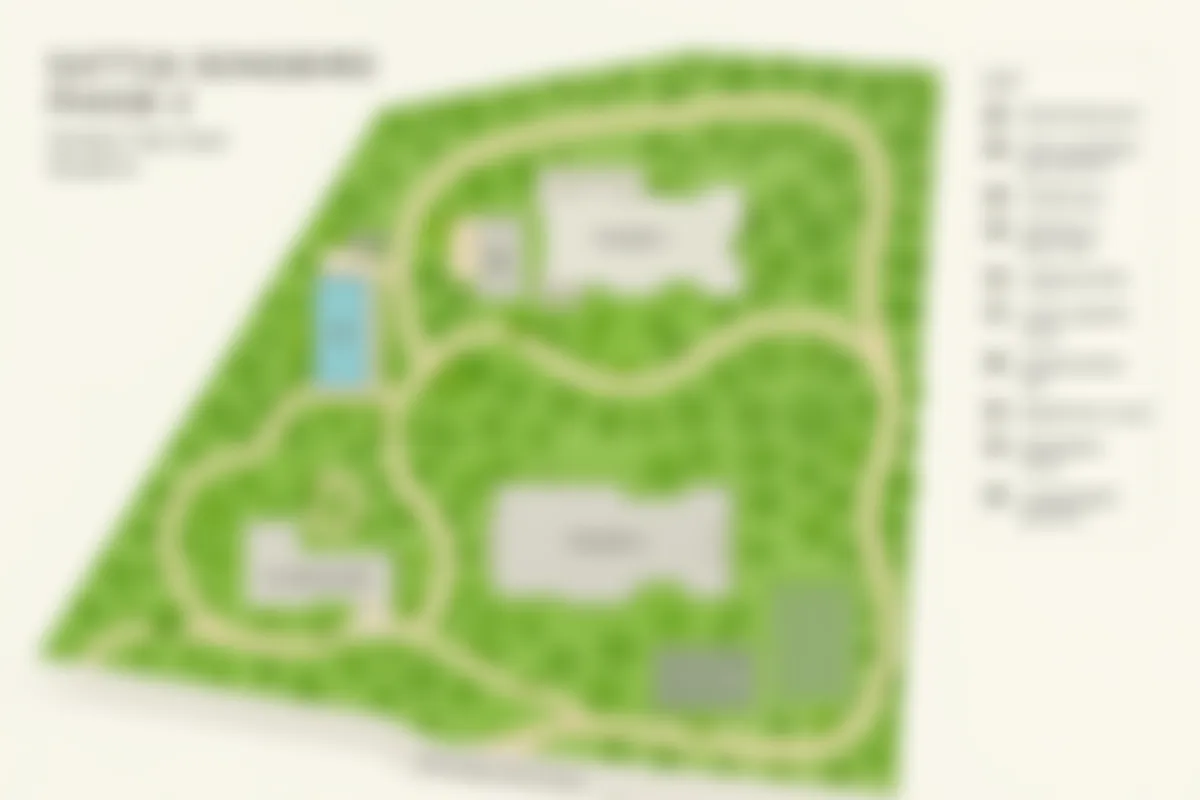
The published graphic shows how Sattva has arranged Phase 2 within the Songbird story: highway-facing frontage, vertical towers, and amenity clusters meant to read as a landscaped campus rather than a tight podium slab. Treat the visual as directional until you hold the latest authority-stamped drawing-pre-launch renders can predate small but important tweaks to driveways, fire-engine loops, or clubhouse footprints.
Use the plan alongside tower floor plates to see whether your shortlist stack sits close to amenity noise, pool humidity, or generator yards. Pair it with the location notes so you understand what lies outside the red line-future roads, adjacent plots, and power infrastructure. Keep a printout in your site-visit folder so you can mark discrepancies the moment you step on mud.
What the site-planning story emphasizes
The bullets below summarise how Sattva is positioning Phase 2 in sales collateral. Each point should send you back to the drawing: verify dimensions, setbacks, and amenity areas against the latest authority-approved plan rather than the first brochure drop.
NH-75 frontage
Highway frontage helps discovery and long-term liquidity, but it also means service traffic, dust, and acoustic load near the lower stacks. On the plan, check how far residential cores sit from the noise wedge and whether landscape berms are shown as buffers.
Twin 42-floor towers
Ultra-tall blocks need generous lift cores, refuge floors, and staging yards. Use the drawing to see crane swing zones during construction and how fire tender routes wrap the podium-details that rarely appear in glossy renders.
Open-space ratio
Ask how much is usable lawn versus slope, service strip, or transformer yard. The master plan should make that distinction legible.
Three clubhouses
Multiple clubs can spread crowding, but they also multiply maintenance costs. Understand which facilities live in which block, what is shared with future phases, and how access control will work when the wider Songbird master community matures.
12-acre Songbird context
Phase 2 is positioned as part of a larger ~12-acre Songbird canvas. Clarify which roads, power feeds, and security perimeters are common infrastructure so you are not surprised by future phase construction outside your tower window.
Homes & balconies
Vastu-led layouts and deep balconies matter only if the plan shows true cross-ventilation without overlooking neighbours. Compare marketing plans to sanctioned drawings before you pay a view premium.
Privacy, view corridors, and neighbour glare
Twin towers on a finite podium mean diagonal views can peek into neighbouring living rooms unless planners offset cores. On the master plan, study the gap between floor plates, the angle toward NH-75, and whether lower stacks stare into amenity decks. Higher floors trade privacy for panorama-decide which compromise fits your household before you pay a floor-rise premium.
Shadow diagrams are rarely published early, but you can still ask how afternoon sun hits west-facing balconies and whether HVAC loads were modelled for glass-heavy stacks. Those details eventually show up in sales agreements as generic clauses; push for specifics while you still have leverage.
If you are comparing two stacks in the same tower, print the plan and trace sight lines with a ruler-small rotations on paper translate to surprisingly different diagonals once you are 120 metres above grade.
How usable the "green" really is
Generous open-space percentages can hide non-walkable slopes, fire-break zones, and transformer clearances. Ask how much of the green is accessible to residents versus service personnel only. Children's play zones should not sit under flight paths for emergency hoists; yoga lawns need distance from generator exhaust.
What "master community" implies for dues, security, and traffic
Shared Songbird infrastructure can mean consolidated security, single utility bulk deals, and coordinated bus bays-or it can mean arguments over who pays for road repairs when Phase 3 still years away. Early buyers should ask how homeowners' association budgets will split between phases, how visitor parking is allocated on match days at the club, and whether commercial parcels (if any) will add traffic unrelated to residents.
Document every verbal promise about "shared" parks or club access: if it is not in the deed or association bylaws draft, assume another phase may paywall it later. That sounds cynical, but it is how mature buyers protect resale value.
For a plotted-community contrast on how master layouts handle roads and parks, browse KNS District 30-different product, but a useful reminder to read external circulation, not only tower glamour shots.
Always reconcile marketing master art with the RERA filing: search the Karnataka portal using PRM/KA/RERA/1251/310/PR/270326/008557 and download the attachments your lawyer needs.
What sits below the podium-and why it matters upstairs
Most buyers stare at the rendered sky gardens and ignore the basement stack. Transformer yards, diesel storage for backup, pump rooms, and solid-waste segregation chambers belong on your mental map. Ask how flood levels were modelled for the basement ramps, how firefighting pumps are duplicated, and where hazardous material movement happens relative to the kids' play lawn. A clean master plan labels these elements; a vague render hides them.
Vehicle counts spike when 381 homes arrive across two towers. Study the entry and exit arrows: bidirectional gates reduce queues but need more staffing. Visitor parking that looks generous on paper may shrink once ride-share lanes and delivery bays appear-confirm counts for weekends, not just Tuesday afternoons.
Storm-water holding and recharge pits must fit inside the same podium footprint; ask whether maintenance crews can access pumps without entering private parking aisles-operations detail separates smooth societies from frustrated ones.
Future-proofing the boundary conditions
Master plans should show the plot edge: where the compound wall meets the highway verge, how pedestrian access is safeguarded, and whether future authority road widening could shave setback. If commercial frontage is planned along the highway, ask about delivery vehicle stacking and night-time noise from rooftop plant decks on those blocks.
Inside the line, retail pods can be convenient or chaotic. A compact convenience store differs from a restaurant row exhausting kitchen fumes toward balconies. Insist on seeing mechanical ventilation notes for any F&B lease line the developer quietly assumes.
Buyers financing through banks should loop their technical advisor in early: lenders sometimes flag odd podium shapes or incomplete fire-compartment drawings, and you do not want that surprise after you have paid a booking cheque.
When you compare with another high-rise launch, Hallmark Altus in Hyderabad is a reminder that sky decks and sky clubs shift structural loads-always ask how those features appear on structural drawings, not only on marketing fly-throughs.
Finally, connect the master plan to the human rhythm of the project: school-bus staging, domestic-help entry queues, and festival crowd flows around the clubhouse. A plan that looks balanced on paper can feel cramped in life if those movement patterns were never simulated-push the sales team for operations narratives, not only glossy renders.
Print the master plan at legible scale, mark the tower you are considering, and trace every line of sight to podium plant areas, driveways, and future phase voids. Fifteen minutes with a highlighter beats an hour of animated fly-throughs for understanding what you are actually buying.
Sattva Songbird - Enquire Now
Use the enquiry page to request project documents, pricing help, or a callback from the project desk.
Sattva Songbird Master Plan - Frequently Asked Questions
Phase 2 is planned across roughly 4 acres with two ultra-high-rise towers and 381 apartments. The published schematic shows peripheral landscape, drop-offs, and amenity pockets wrapping the twin-tower core.
The plan uses a twin-tower composition with a podium-and-tower logic that places parking decks and clubhouse levels below the residential stack. Confirm the inter-tower distance, resident entry zones, and orientation against your preferred unit before freezing a stack.
Collateral attributes about 80% open space across the 4-acre Phase 2 parcel. Ask the desk for a marked-up plan that separates true walkable lawn from setbacks, slopes, podium edges, and service strips before treating it as usable green.
Phase 2 is described as part of a larger Songbird development, so security, landscape continuity, and approach roads will eventually be shared with future parcels. Clarify which clubhouses, sports courts, and outdoor zones hand over with Phase 2 versus arriving with later phases.
Yes - brochure drawings can be revised between marketing cycles even after RERA registration. Request the stamped drawing revision table from the sales desk so any changes to tower placement, podium layout, or amenity locations are visible to you.
An indicative master plan schematic is on the master plan page on this site, and a stamped sanctioned plan is available with the sales team. Always ask for the latest dated drawing before committing to a tower or floor selection.